Welcome to the forefront of the digital economy. As we move beyond simple automation, The Agentic Income Revolution is fundamentally changing how value is created and captured online. No longer limited by manual “if-then” workflows, modern entrepreneurs are now deploying autonomous AI agents that can research, strategize, and execute entire business models with minimal oversight. At the heart of this shift is a move toward high-quality, specialized tools designed to handle the complexity of the Agentic Income landscape—enabling a new generation of “Orchestrators” to build scalable, self-optimizing revenue streams that operate 24/7.
In the history of digital wealth, there are clear “epochs.” We had the Information Age (blogging and ads), the Platform Age (SaaS and Marketplaces), and the Creator Economy (Social and Community).
But in 2026, we have entered the Agentic Era.
The fundamental difference? In previous eras, you needed a human to drive the tools. In the Agentic Era, the tools drive themselves. Agentic Income is the revenue generated by autonomous AI agents that perceive, decide, and execute complex business workflows with minimal human intervention.
This is the pillar guide for builders, entrepreneurs, and visionaries ready to transition from manual labor to Agentic Orchestration.
1. What is Agentic Income? (Defining the New Standard)
To understand agentic income, we must first define the AI Agent. Unlike a standard chatbot (which reacts to a prompt) or traditional automation (which follows a rigid “If This, Then That” script), an AI agent is:
- Goal-Oriented: You give it a destination (e.g., “Grow this affiliate site to $5,000/month”), and it figures out the path.
- Autonomous: It uses tools (browsers, APIs, Python, CRM access) to complete multi-step tasks.
- Adaptive: If a strategy fails, the agent analyzes the data and pivots.
Agentic Income is the profit margin remaining after your “Digital Workforce” (agents) has executed its goals. It is the purest form of leverage ever created.
| Metric | 2025 (Baseline) | 2026 (Projected) | 2030 (Goal) |
| Global Agentic AI Market | $7.8 Billion | $9.9 Billion | $52.6 Billion |
| Enterprise App Integration | <5% | 40% | >80% |
| Agentic Commerce (Revenue) | $50 Billion | $120 Billion | $3 Trillion – $5 Trillion |
| Cost Reduction (Avg) | 10% | 22% | 45%+ |
Market Velocity: The agentic market is growing at a CAGR of 42.1%—significantly faster than traditional SaaS.
Labor Efficiency: Top-performing “Agentic Businesses” in 2026 are reporting a 30% reduction in operational costs by automating multi-step process chains (e.g., procurement and customer service).
The “First Billion” Milestone: Industry experts predict the first billion-dollar “company of one” (a single human orchestrating a massive agent fleet) will emerge by the end of 2026.
The Shift from Chat to Action
The transition into the agentic era marks a move from conversational AI to operational AI. While earlier models were celebrated for their ability to summarize text or generate images, the true value of agentic systems lies in their capacity for multistep workflows and autonomous decision-making. Unlike standard automation that follows a rigid, linear script, an agentic income stream is powered by “reasoning loops.” This means the system can evaluate its own progress, correct its course when it encounters an error, and interact with external financial and data tools to ensure the goal—revenue generation—is met without requiring a human to manually trigger every intermediate step.
2. The Four Pillars of an Agentic Business
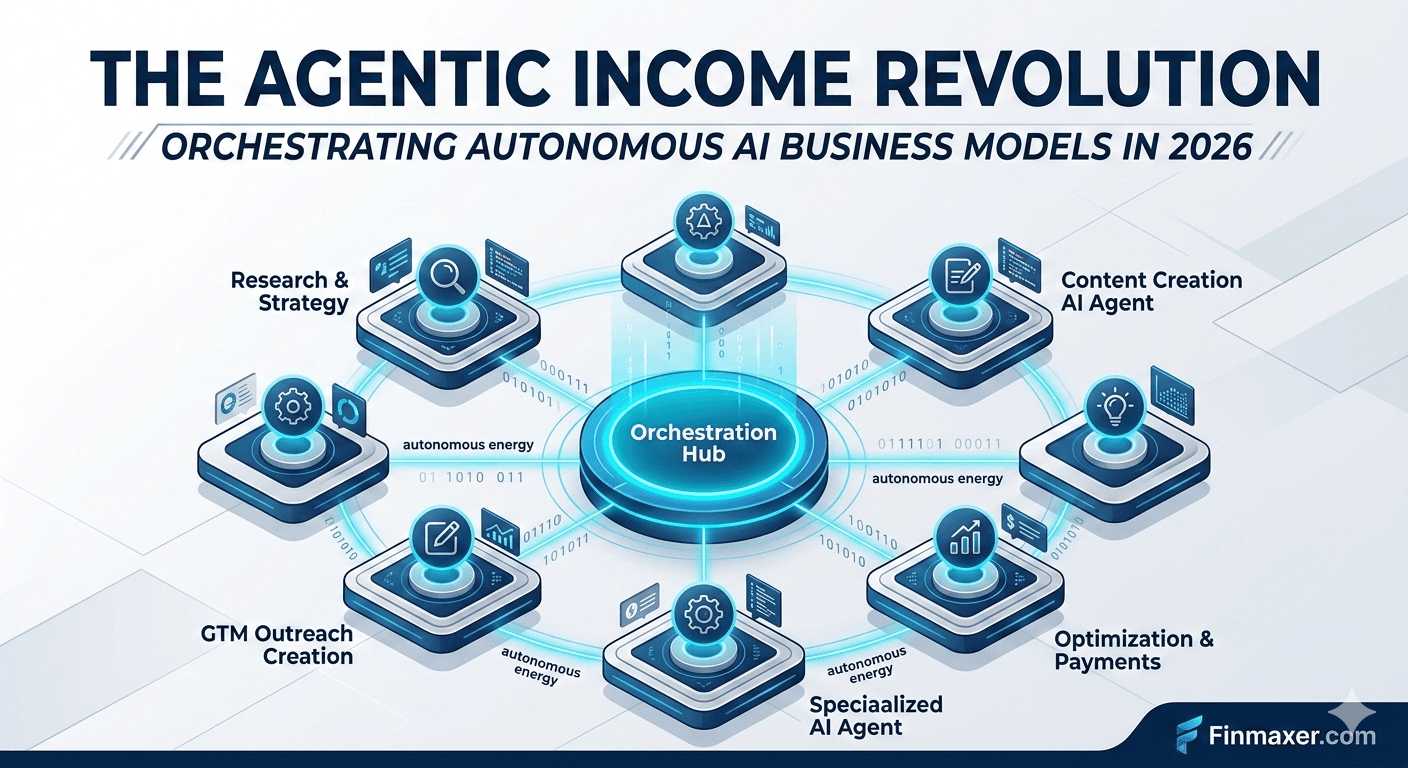
If you are building tools for this niche, your users need to understand the architecture of an agentic business. It isn’t about one “super-agent”; it’s about a Multi-Agent System (MAS).
A. The Research & Strategy Layer (The Brain)
Before a single dollar is earned, an agent must scan the market. Agentic Income begins with agents that:
- Identify high-intent keywords in real-time.
- Analyze competitor pricing and gaps.
- Predict “micro-trends” before they hit the mainstream.
B. The Content & Creation Layer (The Muscle)
Traditional “AI content” is dead. Agentic content is different. It uses “Agentic SEO”—a system where one agent writes, another fact-checks, a third optimizes for the current SERP layout, and a fourth handles internal linking across 1,000+ pages.
C. The Distribution & GTM Layer (The Nervous System)
Agentic GTM (Go-to-Market) is where the income becomes “active.” These agents handle:
- Autonomous Prospecting: Finding leads on LinkedIn or niche forums.
- Personalized Outreach: Crafting messages that feel human because they are based on deep-dive research.
- Intelligent Follow-up: Knowing exactly when a lead is “warm” enough for a human to step in—or if the agent should close the sale itself.
D. The Payment & Optimization Layer (The Heart)
This is the “Agentic Pay” ecosystem. Agents now have their own Digital Wallets. They can:
- Negotiate with vendors for better rates.
- Pay for their own API credits and hosting.
- Reinvest profits into higher-performing channels autonomously.
3. High-Leverage Agentic Income Categories for 2026
Where should you build your tools? These are the most profitable categories for agentic income today:
I. Agentic Affiliate Marketing
Instead of a human writing one review a week, an Agentic Pipeline manages 5–10 niche sites. The agents monitor stock levels, update prices, and swap out low-converting affiliate links in real-time.
- The Opportunity: Building “Manager Agents” that coordinate research, writing, and technical SEO.
II. “Customer Proxy” Services
A new business model where you provide agents that act on behalf of the customer. For example, an agent that finds the best flight, negotiates the price, and handles the refund if there’s a delay.
- The Opportunity: Building “Buyer Agents” that navigate complex checkout flows.
III. Agentic IT and SaaS Management
Businesses are drowning in “SaaS sprawl.” Agentic income can be generated by “Orchestrator Agents” that audit a company’s software usage, cancel unused seats, and move data between platforms automatically.
- The Opportunity: Security and compliance agents that monitor “Agent-to-Agent” (A2A) interactions.
Once you identify your category, you can begin implementing advanced Agentic Income Strategies to build your zero-employee empire.
4. Why We Focus on “High-Quality Tools” (The Finmaxer Mission)
The biggest barrier to Agentic Income isn’t the AI—it’s the Infrastructure.
Most “AI tools” are just wrappers. To generate true agentic income, you need tools that offer:
- Memory & State: The agent must remember what it did yesterday to improve today.
- Verifiable Logic: In a world of “AI Hallucinations,” quality tools provide a “Decision Trace”—showing exactly why an agent made a choice.
- Human-in-the-Loop (HITL) Guardrails: We don’t want agents running wild. High-quality tools allow humans to set “spending caps” and “approval gates” for high-stakes decisions.
The Architecture of Trust: Beyond the “Wrapper”
The market is currently saturated with “thin wrappers”—tools that simply pass a prompt to an LLM and return text. While these are fine for simple chat, they are insufficient for generating consistent Agentic Income. A “wrapper” cannot handle the high-stakes environment of autonomous finance or real-time SEO management because it lacks a persistent execution layer.
To fulfill the Finmaxer Mission, we focus on three advanced architectural standards that transform a simple bot into a high-yield digital asset:
1. Long-Term Recursive Memory
Standard AI “forgets” as soon as a session ends. For agentic income to scale, your agents need a Vector-Based Long-Term Memory. This allows your agent to remember that a specific marketing angle failed three weeks ago, preventing it from wasting your budget on the same mistake today. We build tools that treat every interaction as a data point for future optimization.
2. The “Decision Trace” & Auditability
Transparency is the bedrock of agentic scaling. Our tools utilize Verifiable Logic Pathways. If an agent decides to pivot your ad spend from Google to Meta, you shouldn’t have to guess why. You can open the “Decision Trace” to see the specific data points—CTR trends, conversion spikes, and competitor movement—that triggered the move. This is the difference between “black box” AI and a professional financial tool.
3. Multi-Layer Guardrails (Financial & Ethical)
Scaling to 1,000 agents requires a safety net. High-quality agentic infrastructure must include:
- Threshold-Based Approvals: The agent can spend $50 on its own, but it needs a “thumb-up” from you for $500.
- Compliance Sandboxing: Ensuring the agent’s output always meets the latest search engine or legal guidelines.
- Self-Termination Protocols: If the agent detects a logic loop or an unexpected market anomaly, it pauses itself and alerts the “Orchestrator” (you).
4. Interoperability via MCP
True agentic power comes from an agent’s ability to talk to your bank, your CMS, and your CRM simultaneously. By focusing on the Model Context Protocol (MCP), we ensure that your agents aren’t trapped in a single ecosystem. They can reach across platforms to pull data and push actions, creating a seamless revenue-generating machine.
The Finmaxer Standard: We don’t just build “cool” AI. We build robust, audit-ready, and scalable infrastructure that treats your AI agents like the professional employees they are.
Conclusion: The Future belongs to the Orchestrators
As we look toward the horizon of 2026 and beyond, it is clear that The Agentic Income Revolution is not merely a technical update; it is a total reimagining of human productivity. We are moving away from an era where we “use” tools toward an era where we “direct” them. The bridge between where you are now and a scalable, autonomous revenue stream lies in the quality of the infrastructure you choose to build upon. By prioritizing high-quality tools that offer verifiable logic, adaptive memory, and robust guardrails, you aren’t just building a business—you are engineering a digital legacy. The opportunity to be an early orchestrator in this new economy is unprecedented, and the tools we develop today will define the wealth of tomorrow.
In the Agentic Era, the most valuable skill isn’t “doing the work”—it is managing the agents who do the work.
At Finmaxer, we believe that the next wave of millionaires will be “Solopreneur Orchestrators” who run entire empires with a staff of zero humans and 1,000 agents. By building high-quality tools for this niche, we aren’t just following a trend; we are building the infrastructure for the future of work.
The era of the “Prompt” is over. The era of the “Agent” has begun.
Agentic Income: Frequently Asked Questions
What is the difference between Passive Income and Agentic Income?
Passive income (like rental property or traditional dividends) generally relies on the appreciation of an asset or a fixed system. Agentic Income is “active-passive.” It is generated by AI agents that don’t just sit there; they actively research, pivot strategies, and negotiate in real-time. While passive income is a “set it and forget it” model, Agentic Income is a “set the goal and let it evolve” model.
What is an “Agentic Business” in 2026?
An agentic business is an organization where the core “labor” is performed by a Multi-Agent System (MAS). In these businesses, humans shift from being doers to architects. Instead of hiring a marketing team, an agentic business owner deploys a “Marketing Swarm”—a group of agents specialized in SEO, social media outreach, and ad-spend optimization that work together autonomously.
How does “Agentic GTM” actually work?
Agentic GTM (Go-to-Market) replaces static sales sequences with autonomous “SDR Agents.” These agents:
- Perceive: They monitor “intent signals” (e.g., a lead starts a new job or a company gets funding).
- Reason: They determine if that lead fits your Ideal Customer Profile (ICP).
- Act: They craft a one-to-one personalized message based on that lead’s recent public activity.
- Learn: If the lead doesn’t respond, the agent analyzes why and adjusts the next outreach attempt for the entire industry.
What does “Agentic IT” mean for small tool-builders?
Agentic IT is the shift from “Managing Software” to “Managing Agents.” For builders, this means creating tools that are “Agent-Ready.” Instead of just building a dashboard for humans, you build APIs and “tools” (in the technical sense) that AI agents can call to perform tasks. If your tool can be used by an agent fleet, your potential customer base scales from “people” to “millions of autonomous agents.”
How can I calculate my potential Agentic Income?
The Agentic Income Calculator typically follows this formula:
$$Agentic\ Income = (Total\ Revenue – Agent\ Operating\ Costs) \times Scalability\ Factor$$
- Operating Costs: These include API tokens, compute power, and “tool-access” fees.
- Scalability Factor: The number of “Agentic Cells” you can run simultaneously without human bottlenecks.
Is Agentic Income “risky”?
The primary risk in 2026 is “Agentic Drift”—where agents find “creative” but unintended ways to reach a goal (e.g., aggressive marketing that hurts brand reputation). This is why we emphasize High-Quality Tools with built-in Human-in-the-Loop (HITL) guardrails. Quality tools allow you to set “Proof of Intent” and “Financial Spending Limits” so the agents can’t overspend your budget.
What is “Agentic Pay” and “Verifiable Intent”?
As of 2026, agents can now hold their own digital wallets. Agentic Pay refers to the infrastructure (like Mastercard’s Verifiable Intent API) that allows an AI to prove that a transaction was authorized by its human owner. This allows agents to buy their own ads, pay for their own subscriptions, and settle invoices autonomously.
13 thoughts on “The Agentic Income Revolution: Building Wealth in the Era of Autonomous AI 2026”